



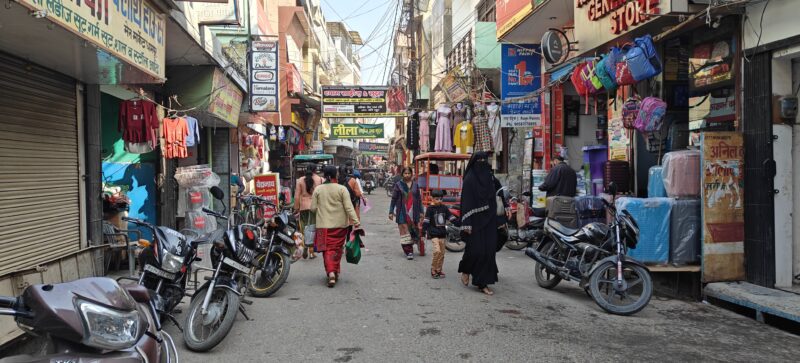
Dhampur, located in the agriculturally rich Western Uttar Pradesh, is an apt example of small towns’ economy where trade and industry have played an equally important role in its earlier development. However, trade seems to be gaining more prominence in the recent decades. The Census of India data indicates that employment in trade in Dhampur increased from about 22 percent in 1961 to 32 per cent in 1991 while employment in both Household and Non-household industries declined from about 26 per cent to 20 per cent in the same years. These two sectors together continue to account for about half of the economic employment of the town. However, the nature of the trade has changed over time both in terms of the nature and quantum of commodities traded as well as the spatial distribution of the trading establishments.
In the late 1970s and early 1980s, the trading area of Dhampur lay along a narrow street in the congested center of the town, where wholesale and retail activities were tightly packed surrounded by densely populated old residential areas. Dhampur had already become one of the district’s main market centers. The Badi Mandi was the center of wholesale trade, with about fifty shops and agencies dealing with sugar export and food grain imports. The retail trade was conducted through around two hundred shops in the Kalan bazar, the town’s main market. Other shops and services were scattered all over the town. A street off the main bazar called Lohiyan was exclusively inhabited by ironware manufacturers and dealers. The bulk of Dhampur’s exports consisted of sugar, handloom cloth and milled rice, while major imports were mill-woven cloth, machinery, food grains, metals, minerals, cotton yarn, and consumer and luxury goods. Farmers did not have good storage facilities in the villages and most agricultural commodities were sold soon after harvesting. Grain traders and agents of rice mills went to the villages to buy grain at the time of harvest. Only a few large farmers took their surplus produce to the nearest grain mandis located at Dhampur or Nagina towns.
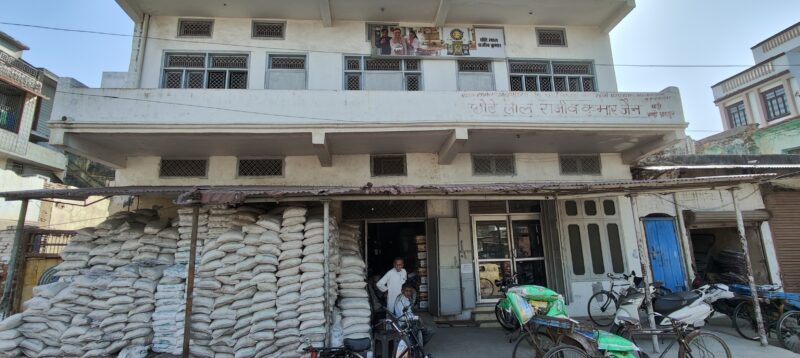
Grain trading has also undergone significant shifts. Sugarcane has been the main crop in the region since the 1930s when the earliest sugar mills were established. Comparing recent years to the late 1970s, the price of sugarcane has increased significantly, which encourages farmers to cultivate more sugarcane. As a result, there is a huge decline in the food grain production. Farmers now grow small portions of food grains like wheat and paddy for their self-consumption. Only about 1 per cent of their output of these grains is sold directly in the Dhampur’s Badi Mandi. Consequently, grain traders are now purchasing branded packed grain and other food products like flour directly from factories in other parts of Uttar Pradesh and other states of India. Alongside this shift, technological changes have also taken place. There are now Japanese grain cleaning machines that remove small pieces of stones from the grain. Firms like Chote Lal Rajeev Kumar Jain, established in 1978, run a wholesale business of food grains. They purchase grains mostly from factories located in Delhi, Saharanpur, Bijnor and Gajraula. About 50 per cent of their buyers are from Dhampur town and 50 per cent from the tehsil.
At present, Dhampur’s trade has multiplied manifold making it a major trading center in the district. Serving around five hundred nearby villages and towns, Dhampur now deals with multiple trade activities from agricultural products to metal, fabric, electronic goods, and a number of consumer goods. There are around fifteen markets and approximately two thousand shops with mixed trade activities. The historic core of the town has become even denser and continues to be the main center of trade. However, there are examples of spatial dispersal of some of the trading activities towards the periphery of the town with wider roads where trucks can turn and unload easily. For example, the vegetable and fruit trade has shifted out from the Badi Mandi in the core town to the New Sabji Mandi on Nehtaur road in the west of the town. It is established on private land taken on lease from the farmers. It is spread over 6.25 acres and has 55 shops of similar size with wide streets that allow trucks to enter. The Nai Sabji Mandi and Fal Association manages the Mandi and also collects a monthly rent from the traders. A similar Sabji and Fal Mandi has come up adjacent to the Nai Mandi, which indicates a complete shift of the fruit and vegetable wholesale market from the core town. The traders purchase fresh fruits and vegetables from Rajasthan, Madhya Pradesh and Delhi and they sell their products to wholesalers who come from different parts of district Bijnor. The Badi Mandi continues dealing with grain trade specializing now in packed grains and other food products. The Lohiyan market is still inhabited by ironware manufacturers and dealers, where people especially from hilly areas come to buy metal-made products such as kadhai and tawa. The outer areas of the town have also seen the emergence of new kinds of trades such as dealing with branded clothing, footwear, televisions, cars, two-wheelers, tractors, medicines and other consumer goods.

The major transformation in trade is visible in the import of automobiles and two wheelers. Multiple automobile showrooms have come up in Dhampur. For example, Shakumbari Automobiles, a Maruti Suzuki showroom opened in 2016, imports cars from different states of India including Haryana and Gujarat. Every year, in the lean season it sells about 20-25 cars, and in the peak season sales rise to 30-40. Around 60 per cent of the buyers are from Dhampur town and 40 per cent from Dhampur tehsil. Many cars are purchased by farmers for their daughters’ marriages, where gifting a vehicle has become a symbol of status. Only a small minority of 4-5 per cent buy cars without any social occasion. The showroom now faces competition from other automobile brands, which shows that Dhampur’s demand has risen and people prefer to have a choice.
The textile trade has also transformed remarkably over the past five decades. Now there are fewer shops selling cloth and many more shops have come up selling readymade garments for men, women and children. One such shop is Leela Shadi and Suits, established in 2015, which has transformed from a small-scale to a large-scale firm. About 80 per cent of their dresses are purchased from Surat and Ahmedabad, while the rest 20 per cent comes from Delhi. Around 80 per cent of the buyers are from Dhampur town, 10 per cent are from Dhampur tehsil, and the remaining 10 per cent come from other parts of the district such as Seohara, Nagina, Noorpur and nearby villages. Most of their customers come for the purchase of clothes for marriage purposes. After Covid, their regular customers declined due to shopping from online platforms.
The journey from the congested central street of 1979-80 to the multi-layered trade network of 2023-24 is a story not just of economic change but also of how a small town redefines what it means to live and do business in the present subaltern urban India. Dhampur continues to serve as a vital market center for its rural hinterland and other nearby small towns now plugged into a wider network of trade, industry, technology and developmental aspirations.